
The Hidden Cost of Manual Salon Management Explained
QuarkBooker Team
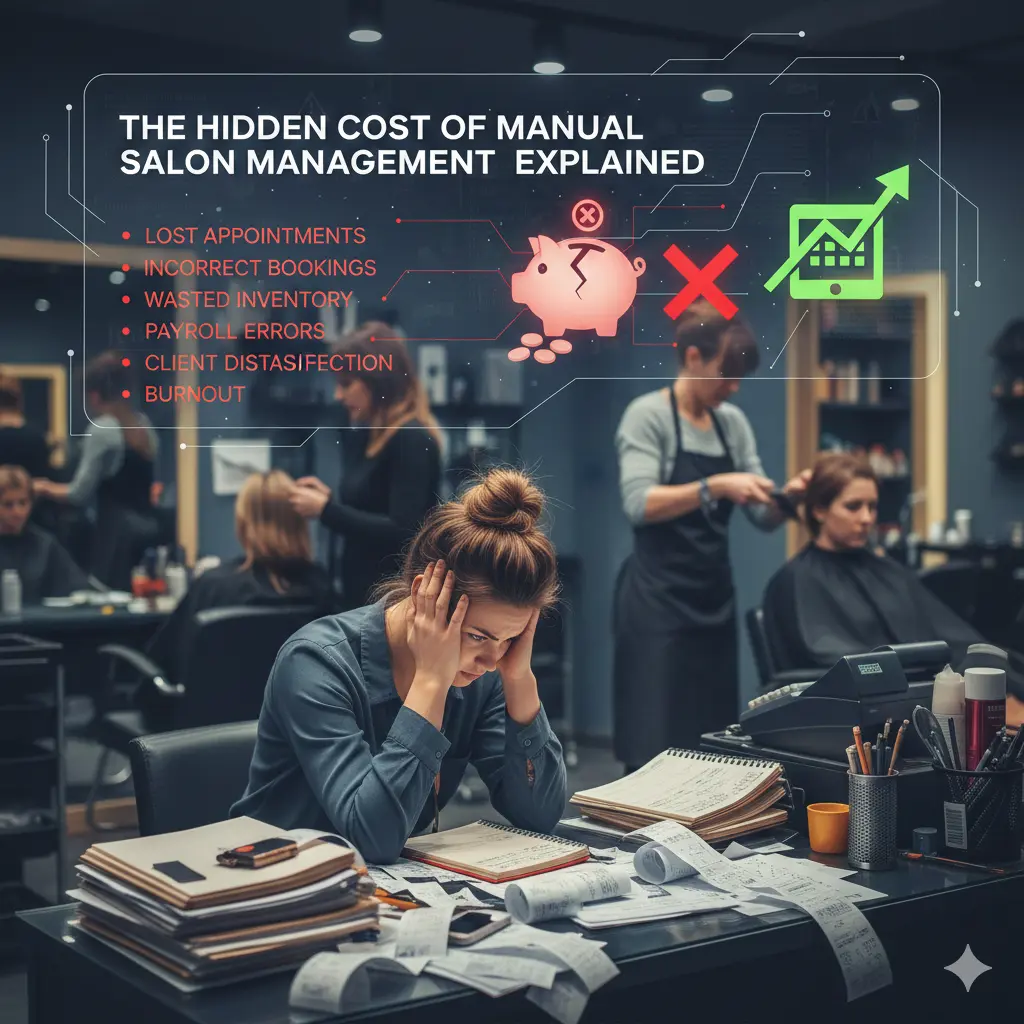
Most salon owners believe manual management saves money.
In reality, it quietly drains profit, energy, and growth — without ever showing up as a clear expense.
The most dangerous costs in a salon are not rent or products.
They are the costs you don’t track, don’t calculate, and don’t see.
This article breaks down the hidden cost of manual salon management — and why professional salons eventually move to structured systems.
Manual Management Feels Cheap — Until You Measure It
Manual management usually looks like this:
- Bookings handled via WhatsApp, calls, or memory
- Schedules adjusted verbally
- Staff reminders repeated daily
- Owner involved in every small decision
Nothing looks expensive.
But everything becomes dependent.
Operations research shows that unstructured processes increase operational friction and reduce efficiency over time (McKinsey & Company):
👉 https://www.mckinsey.com/capabilities/operations/our-insights
Hidden Cost #1: Lost Time (The Most Expensive Resource)
Manual salons lose time in small pieces:
- Answering booking questions repeatedly
- Fixing double bookings
- Explaining schedules again and again
- Solving misunderstandings
Owners rarely calculate this time — but it adds up to hours every week.
Time spent managing chaos is time not spent on:
- Growth
- Marketing
- Team development
- Client experience
Time loss is profit loss.
Hidden Cost #2: Invisible Revenue Leakage
Manual management creates silent revenue leaks:
- Missed appointments without deposits
- Empty slots caused by miscommunication
- Services running longer than planned
- Pricing applied inconsistently
These losses don’t show on invoices — but they show in monthly results.
Professional salons use systems to lock structure into operations, reducing these leaks automatically.
You can explore more insights like this on our
👉 /blog
Hidden Cost #3: Staff Friction and Turnover
Manual rules create confusion:
- “I didn’t know my shift changed”
- “No one told me”
- “That rule wasn’t clear before”
Unclear expectations lead to tension — and tension leads to turnover.
Workplace research consistently shows that unclear policies and inconsistent enforcement are major causes of internal conflict (Harvard Business Review):
👉 https://hbr.org/2015/01/what-great-leaders-do
Replacing staff costs far more than preventing confusion.
Hidden Cost #4: Owner Burnout (The Silent Killer)
In manual salons, the owner becomes:
- The scheduler
- The reminder system
- The problem solver
- The rule enforcer
This creates constant mental load.
Burnout doesn’t happen suddenly — it builds slowly through decision fatigue and constant interruption.
Structure removes pressure from the owner and places it into systems.
Hidden Cost #5: Inability to Scale
Manual salons don’t scale — they stretch.
As demand increases:
- Mistakes increase
- Stress increases
- Quality decreases
Growth without structure creates chaos.
This is why structured operations are a requirement for scaling service businesses, not a luxury (SHRM):
👉 https://www.shrm.org/resourcesandtools/hr-topics/employee-relations/pages/workplace-policies.aspx
Why Owners Don’t Track These Costs
Because they don’t appear as:
- Invoices
- Subscriptions
- Payroll lines
They appear as:
- Stress
- Missed opportunities
- Inconsistent income
- Constant firefighting
Manual management hides its true price well.
Systems Don’t Replace Owners — They Protect Them
Professional salons don’t manage harder.
They manage once, through structure.
Systems define:
- Availability
- Schedules
- Service duration
- Rules
This removes emotion, repetition, and dependency.
👉 This is why organized salons transition to structured platforms instead of manual coordination.
How QuarkBooker Eliminates the Hidden Costs
QuarkBooker is built to replace manual friction with clarity.
It helps salons:
- Centralize bookings
- Reduce miscommunication
- Enforce structure automatically
- Free owners from daily micromanagement
Instead of managing people verbally, salons manage systems.
👉 Build calm, scalable salon operations here:
Manual Management Is Not Free — It’s Just Uncounted
The question isn’t:
“Can my salon survive without software?”
The real question is:
“How much is manual management already costing me?”
Learn more about how we think about structure, leadership, and modern salon operations on our
👉 /about